Short answer: If you extend your Top Talent Pass (TTPS) through employment, ImmD does not ask for office documents. If you extend through your own business, ImmD’s checklist lists “supporting documents on office set-up (e.g. tenancy agreements)” for a first extension, and ImmD must be satisfied the business is genuinely operating in Hong Kong. Our recommendation: a private office in an office or commercial building (not an industrial building), on a written agreement of at least 12 months.
This guide is for Top Talent Pass holders, many of them from the Mainland, who set up or joined a company in Hong Kong and now face their first extension. We run serviced private offices in Hong Kong. Below is what ImmD’s own documents say, where an office fits in, and how the common office options compare.
Not immigration or legal advice. This guide summarises ImmD’s published guidebook and web pages as of November 2026. ImmD states that “the eligibility criteria may be subject to change from time to time without prior notice” (TTPS guidebook, para 26). Check the current guidebook, and get professional advice for your own case.
What are the two ways to extend a Top Talent Pass?
You can extend either by showing employment in Hong Kong or by showing a business you have set up or joined here. The TTPS guidebook (ID(E) 1026, April 2026, para 15) says applicants must prove they have “taken up employment in the HKSAR with a stable income” or have “established or joined in a business in the HKSAR”.
| Employment route | Business route | |
|---|---|---|
| What you prove | A job in Hong Kong with a stable, market-level income | A business you set up or joined that is genuinely operating in Hong Kong |
| Office documents in ImmD’s checklist | None | “Supporting documents on office set-up (e.g. tenancy agreements)” |
| Extension length | Up to 3 years, or until the employment contract ends if sooner (para 20) | No fixed length: depends on the business factors below (para 20) |
| When to apply | Within 3 months before your stay expires, and at least 6 weeks before (paras 15 and 17) | Same |
Holders who have been on the scheme for at least two years and had assessable income of at least HK$2 million in the previous year of assessment can be granted six years (para 22). The rest of this guide is about the standard business route.
What does ImmD look at when you renew through a business?
ImmD wants to see that the business is real, active and contributing to Hong Kong. Para 19 of the guidebook says the business must be “indeed operating healthily and sustainably in the HKSAR” and “able to contribute to the economy of the HKSAR”. The factors it lists are “turnover, financial resources, investment sum, number of jobs created locally, economic benefits brought by the business”. The same factors decide how long an extension you get.
The guidebook’s document checklist for the business route (Part IX(C)ii) asks for:
| Document | What it shows |
|---|---|
| Business Registration Certificate (and, for a company, its registration documents) | The business legally exists |
| Proof of your absolute beneficial ownership | You own or hold a stake in it |
| Other licences or certificates needed to operate | It can legally do what it does |
| Proof of financial standing, including tax documents for the previous assessment year from the Inland Revenue Department | It has money and files tax |
| Company background: business activities, mode of operation | What it actually does |
| Contracts, invoices or proof of business deals under negotiation | It is trading |
| Proof of posts created for local employees, such as MPF contribution records | It creates local jobs |
| A supporting letter from the company on your contribution to Hong Kong | Your role in it |
| Supporting documents on office set-up (e.g. tenancy agreements) | It operates from real premises |
| Hong Kong Talent Engage’s acknowledgement of the “Exclusive Survey for Top Talent Pass Holders” | A step ImmD requires of TTPS holders |
On ImmD’s TTPS page, the office set-up item is marked for a first extension, or a later extension with a change of company, and not for a later extension without a change of company. So the office question matters most at your first renewal. Q31 of ImmD’s TTPS FAQ adds that business-route applicants must “produce proof of their business” and may be refused if they fail to prove it.
Do you need an office for a Top Talent Pass renewal?
For a first renewal through your business, plan on it. ImmD’s checklist names office set-up documents and gives a tenancy agreement as the example. ImmD does not publish a rule on which kinds of premises it accepts, and it does not say whether a serviced office or coworking agreement counts. What it does say is that it assesses whether the business is genuinely operating in Hong Kong.
ImmD uses similar wording elsewhere. Its investment-as-entrepreneur visa (which does not apply to Chinese residents of the Mainland) lists “Tenancy agreements/supporting documents on office set-up” among the documents applicants upload. Office set-up is a standard piece of evidence that a business is real.
Here is our practical reasoning, not ImmD’s:
- A home address shows where you live, not where the business works. A business with turnover, staff and clients but no premises invites questions.
- A virtual office or mailing address gives the company an address but no agreed workspace. It may be fine for company registration; as evidence that a business is operating from Hong Kong, it is weak.
- An office in an industrial building is not suitable: industrial buildings are generally not meant for office use (see the next section).
- An agreement in the company’s name for a dedicated, signed office in an office or commercial building is the closest a small company gets to a conventional lease without a multi-year commitment.
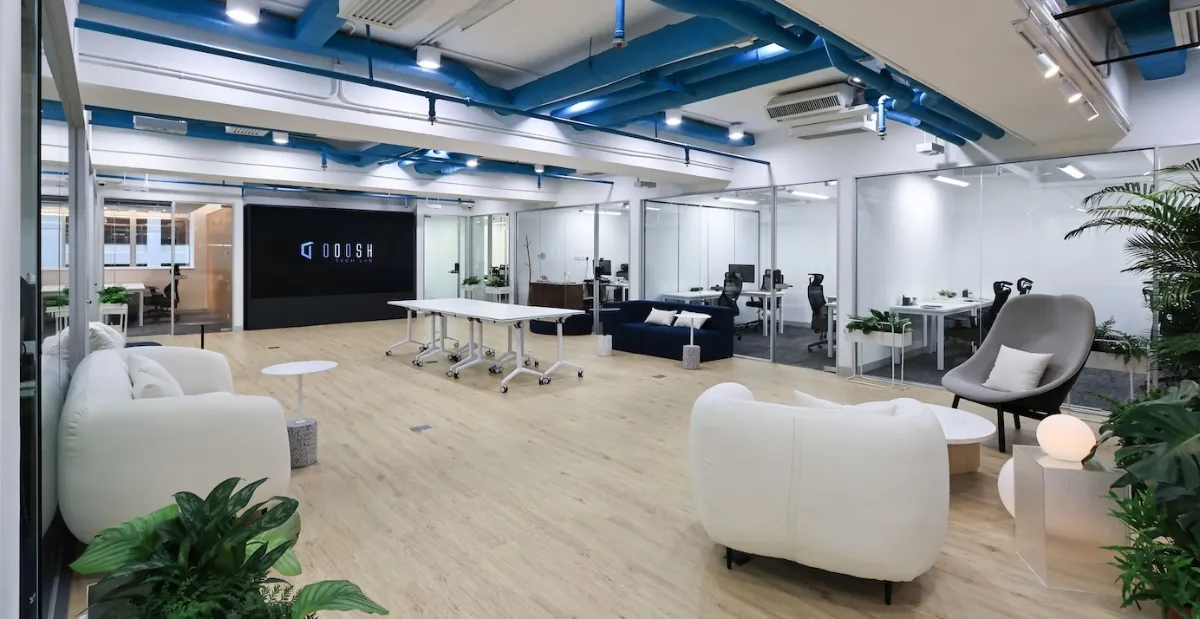
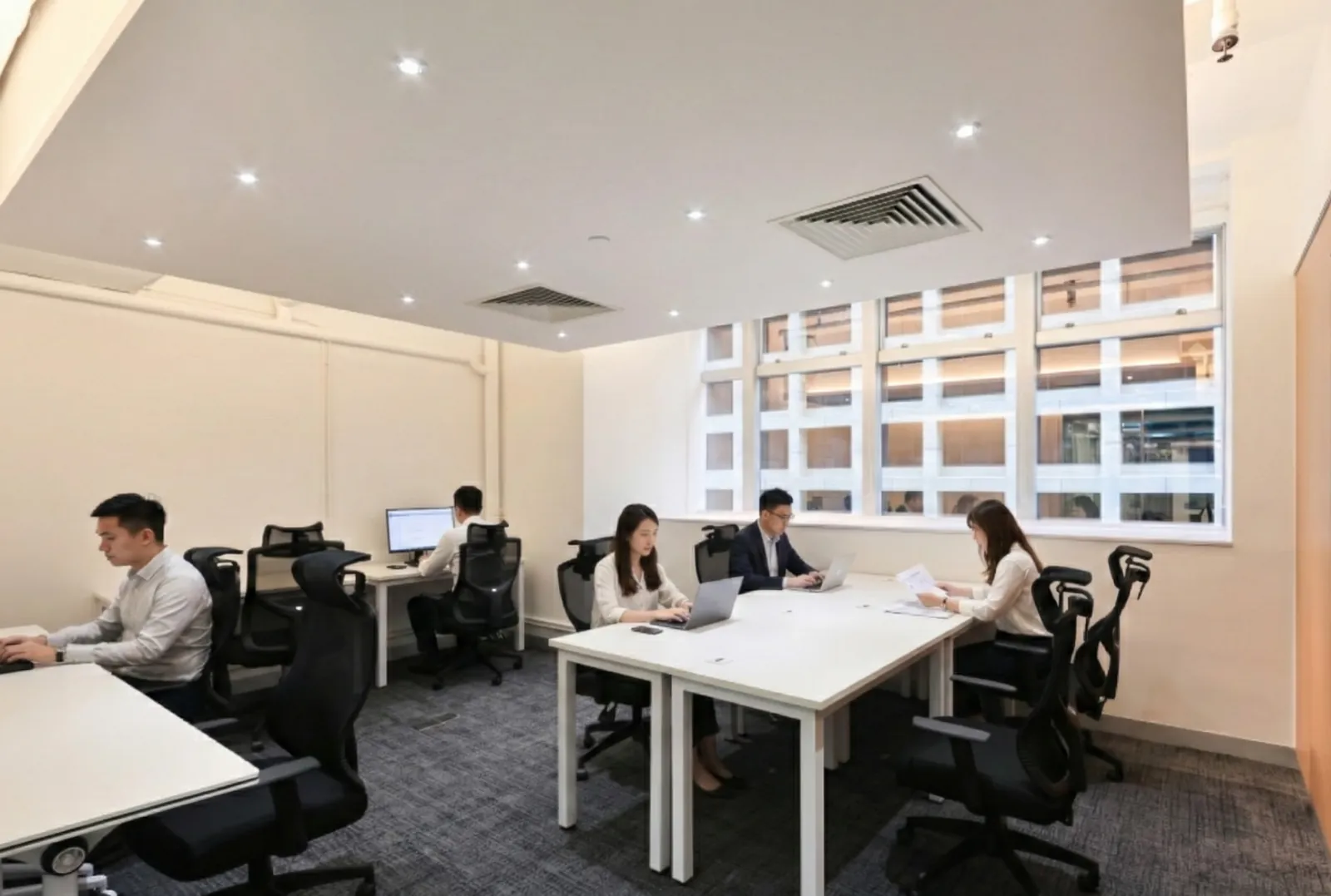
From the formality side, our recommendation is a private office in an office or commercial building, on an agreement of at least 12 months, so officials have no reason to doubt the business. That is Ooosh’s recommendation, not an ImmD rule, and no office arrangement guarantees approval. ImmD weighs the whole picture: turnover, contracts, tax, local jobs.
Can the office be in an industrial building?
We advise against it. Most industrial buildings in Hong Kong may only be used for industrial or warehouse purposes under their land lease. The government told the Legislative Council that “the lease of most industrial buildings specifies that the lot shall not be used for purposes other than “industrial and/or godown"", and that other uses “may be in breach of lease conditions” unless the owner has obtained approval from the Lands Department (LCQ18, November 2015). Office use normally needs a waiver from the Lands Department. A time-limited arrangement lets some office uses in eligible industrial buildings go ahead without a waiver, under conditions (LCQ1, October 2024).
An office set-up document is meant to show that your business operates from proper premises. Your renewal file should not raise the question of whether your office use is allowed at all. Choose an office in a building for office or commercial use, and ask the operator or landlord about the building’s permitted use before you sign.
Does an ASMTP (Mainland talents) holder need an office?
It depends on the employer, because the Admission Scheme for Mainland Talents and Professionals (ASMTP) is employment-based. ImmD’s ASMTP FAQ (Q8) says an application “must be submitted by the employer in the HKSAR and the employer must be a registered company in the HKSAR”. Extensions follow a “3-2 year pattern, also on employment condition” (ASMTP page), and a change of employer needs ImmD’s prior approval.
The ASMTP pages we checked do not list an office document. But if the employer is a company you set up yourself:
- Q6 says “the fact that you are the owner of the company concerned does not exempt you from any of the eligibility criteria”.
- Q3 says a newly established company may apply “together with a business plan and relevant supporting documents”.
A company that sponsors its own founder is in effect asking ImmD to accept that it is a real employer. Premises in the company’s name are part of that picture, for the same reasons as above.
Home, virtual office, desk or private office: which works?
The options differ most in whether the company has an agreement in its own name for a dedicated space you can point to. The last column is our assessment of how well each supports “office set-up” evidence, not a statement of what ImmD will accept.
| Option | Company agreement | Own space | Signage | Evidence (our view) |
|---|---|---|---|---|
| Home address | No | No | No | Weak |
| Virtual office / mailing address | Varies | No | No | Weak |
| Hot Desk (coworking) | A pass only | No | No | Weak |
| Private Desk (coworking) | Varies | A desk in a shared area | Varies | Moderate |
| Serviced private office | Usually | A private room | Varies | Strong |
| Own commercial lease | Yes | Yes | Yes | Strong; usually multi-year, plus fit-out |
Whichever option you choose, the office should be in a building for office or commercial use. At Ooosh, Hot Desk passes are not eligible for this use. We don’t recommend a Private Desk for it either, because we cannot put up company signage at a desk in a shared area.
What does an Ooosh private office include for a TTPS renewal?
For talent-scheme renewals we offer private offices at Central and Island East, both in commercial office buildings. Every Ooosh private office comes with a written service agreement. Here is what matters for your renewal file:
- Business address in the agreement. The agreement states that private office members may use the Ooosh address as their business address.
- Company logo signage in front of your private office.
- Stamping. We can send the agreement for stamping.
- Monthly invoices. Fees are all-inclusive (electricity, management fees, government rent and rates, internet, landline, pantry and basic cleaning), so you get one monthly invoice and no separate utility bills.
- Licensed address provider. Ooosh is a licensed Trust or Company Service Provider (TCSP) under the Anti-Money Laundering and Counter-Terrorist Financing Ordinance (Cap. 615), licensed by the Companies Registry. Members who use an Ooosh address as their business address complete a standard KYC check.
- Refundable deposit, no setup fee, and 24/7 access for private office members.
- Putonghua. Our staff can serve Putonghua speakers.
A renewal through the business route rests on real trading: turnover, contracts, local jobs. Ooosh is a space full of entrepreneurs, and we believe there are business opportunities within our community that are worth exploring.
| Location | Private office from | Nearest MTR |
|---|---|---|
| Island East (Eastern Central Plaza, Shau Kei Wan) | HK$5,000 per month | Sai Wan Ho, Exit B, 6 min walk |
| Central (New World Tower, Queen’s Road Central) | HK$12,800 per month | Central, Exit G, 3 min walk |
Private office prices are starting prices. See our Memberships page, and our Hong Kong coworking and serviced office price guide for how these compare with the market.
Renewing your Top Talent Pass? Book a tour of a private office in Central or Island East, and ask us about a 12-month agreement for your renewal file. We speak Putonghua.
WhatsApp +852 9466 4231 · Call +852 3628 3606 · ask@ooosh.hk · Book a tour
What should you check before you apply?
Two things to get right are timing and documents that match each other. Before the three-month window opens:
- Count back from your limit of stay. Apply within three months before it expires and at least six weeks before (paras 15 and 17). Processing takes about two to three weeks, according to ImmD’s TTPS page.
- Sign the office agreement early. An agreement signed the week before you apply shows less operating history than one that has run for months, with invoices paid against it.
- Make the address consistent. Use the same business address on the Business Registration, the office agreement, invoices to clients, bank statements and tax filings.
- Keep the trading evidence. Contracts, invoices issued, and proof of payments received.
- Keep MPF and tax records. If you employ local staff, MPF contribution records show jobs created. Tax documents for the previous assessment year show financial standing.
- Complete the Hong Kong Talent Engage survey and keep the acknowledgement; it is on ImmD’s checklist.
- Check the current guidebook. ImmD can change the criteria without notice (para 26).
If you want to see a private office before your renewal, contact us to book a tour of a private office in Central or Island East.
Frequently asked questions
Do I need an office to renew my Top Talent Pass?
Only if you renew through the business route. ImmD's checklist for that route lists "supporting documents on office set-up (e.g. tenancy agreements)" for a first extension, or a later extension with a change of company. If you renew through employment, the checklist has no office item.
Can I use a virtual office or my home address for a Top Talent Pass renewal?
ImmD does not publish a rule on virtual offices or home addresses. It does assess whether your business is genuinely operating in Hong Kong. In our view a mailing address with no agreed workspace is weak evidence of that, so we recommend a private office in an office or commercial building, on a written agreement of at least 12 months.
Can I use an office in an industrial building for a Top Talent Pass renewal?
We advise against it. Most Hong Kong industrial buildings are restricted by their land lease to industrial or warehouse use, and office use normally needs a Lands Department waiver. Choose an office in a building for office or commercial use, so the office evidence raises no questions.
How long is a Top Talent Pass extension through the business route?
There is no fixed length. ImmD's guidebook says it considers turnover, financial resources, investment, local jobs created and the economic benefit of the business when deciding how long to grant. Through employment, an extension is up to three years or the end of the employment contract, whichever is shorter.
When should I apply to extend my Top Talent Pass?
Within three months before your limit of stay expires, and at least six weeks before it, according to ImmD. Plan the office agreement, invoices, MPF records and tax documents well before that window opens.
Does an ASMTP (Mainland talents) holder need an office in Hong Kong?
ASMTP is employment-based: the application comes from a Hong Kong-registered employer, and owning that company does not exempt you from the criteria. ImmD's ASMTP pages do not list an office document, but if the employer is your own company, its premises are part of showing it is a real business.